Are my breasts hurting me?
By NuvoPhysio · Updated June 2, 2026

If your bra straps dig into your shoulders by mid-afternoon, if your upper back aches after a long day, or if you find yourself rounding forward without meaning to, the weight you carry on your chest may be part of the story. At Nuvo Physio, we regularly meet women whose neck, shoulder, and back pain is closely tied to large or heavy breasts — a connection that is too often dismissed or simply never explained. This article unpacks what breast hypertrophy is, how it changes the way your spine loads and moves, why it can affect your mood as much as your muscles, and what you can do about it.
The questions we hear most often are surprisingly consistent: Can my breasts really change the structure of my spine? Could heavy breasts be the reason my back hurts? Is the pain in my head? For many women, the honest answer to the first two is yes — and to the third, no. Back pain is one of the most widely recognized consequences of breast hypertrophy and a frequent reason women take medical leave from work.
What does “big breasts” actually mean?
Heavy or large breasts — clinically called breast hypertrophy, mammary hypertrophy, or macromastia — describe an increase in the mass of the mammary glands that is disproportionate to a person’s body size and frame. It is not simply about cup size on a label; it is about how much weight sits on the chest wall relative to the rest of the body.
The overdevelopment of both the milk-producing glandular tissue and the surrounding fatty (adipose) tissue can contribute to this added mass. Breast hypertrophy is most commonly seen after puberty, after pregnancy and during breastfeeding, and in women carrying excess body weight. A degree of natural asymmetry between the two breasts is completely normal, but hypertrophy usually shows up on both sides. One clinical indicator of abnormal size is when breast weight exceeds roughly three percent of total body weight.
None of this is a flaw or a failure of the body. It is anatomy. But anatomy has consequences — and understanding them is the first step toward feeling better.
How heavy breasts change the spine
The connection between breast weight and posture is not theoretical. In research conducted at McGill University, simulated breast weight ranging from roughly 300 to 800 cubic centimetres was added to each side of a participant’s chest. Within ten seconds, measurable changes appeared in the thoracic-lumbar angle of the spine: with each increase in chest-front weight, the upper spine bent further forward.
That is a snapshot taken in seconds. Now imagine that same forward pull repeated through every standing, walking, and sitting moment, year after year. Over time the body adapts — and not always for the better. The muscles along the back of the spine and across the shoulders are asked to work constantly to counterbalance the load in front. The result is a familiar cluster of complaints:
- Overstretched, fatigued muscles across the upper back and between the shoulder blades.
- Tightness and shortening in the chest and the front of the shoulders.
- Grooves and irritation where bra straps press into the shoulders.
- Persistent aching in the neck, shoulders, and mid- to lower back.
Picture a spine that is balanced and upright when the chest load is proportionate to the body. Add significant weight to the front, and the curve shifts — the head drifts forward, the upper back rounds, and the whole postural chain reorganizes around the new demand. That reorganization is where much of the pain begins.
Why this is more than a posture problem
It would be easy to file this under “posture” and stop there, but the picture is bigger. The same forward-rounding pattern that develops to manage breast weight also changes how you breathe, how your core engages, and how load travels down through the spine to the pelvis. We see this often in our work with the whole kinetic chain — the body rarely changes one link without affecting the others.
If you are also managing pregnancy or the postpartum period, breast size can increase substantially during this time, layering a new chest load on top of the postural and core changes that pregnancy already brings. Many women navigating pregnancy-related pelvic and girdle pain are surprised to learn that the strain they feel up high in the back and the strain they feel down low can share roots in the same shifted posture and overloaded support system.
The link between breast hypertrophy and mental health
Pain that lives in the body almost never stays only in the body. For many women, breasts are bound up with a sense of femininity and self-esteem, and living with breast hypertrophy can bring real distress around self-image, self-consciousness, and feeling visible in a way that is unwanted. This is especially common in teenagers, where a rapid increase in breast size after puberty can prompt self-protective habits — hunching the shoulders forward to hide the chest, for example — which then feed directly back into the postural and spinal changes we just described.
Research has found that women living with symptomatic breast hypertrophy can experience higher rates of depression, anxiety, and lower self-esteem than women who have had breast reduction surgery. There is also a well-documented relationship between psychological factors and back pain: how a person feels emotionally influences how they perceive pain, and emotional distress is recognized as a risk factor for pain becoming chronic. A correlation between depression and back pain has been described in the literature.
In other words, the physical and the psychological are not separate tracks. Heavy breasts can pull the spine forward and pull the mood down at the same time, and each can reinforce the other. Recognizing this is not about “it’s all in your head” — it is the opposite. It validates that the discomfort is real, multi-layered, and worth taking seriously.
What you can do about it
The encouraging news is that much of the load-related strain is responsive to the right support. Surgical breast reduction is one well-studied option that many women find life-changing, but it is far from the only lever, and it is rarely the first step. Conservative, physiotherapy-led strategies can make a meaningful difference — whether you are weighing surgery, are not a candidate for it, or simply want to feel and function better in the body you have now.
Build the muscles that hold you upright
Strengthening the deep postural muscles of the upper back, between the shoulder blades, and around the spine helps your body counterbalance the forward pull rather than collapsing into it. We pair this with releasing and lengthening the tight chest and shoulder muscles that the rounded posture tends to create.
Train the whole support system, including the core
Posture is a full-body affair. A well-coordinated core — the deep abdominal and back muscles working together — gives the spine the stability it needs to carry an uneven load with less fatigue. This connection matters especially after pregnancy, when the abdominal wall may also need rebuilding; our guide to core recovery after diastasis recti walks through how that foundation is restored.
Optimize support and daily habits
A properly fitted, supportive bra genuinely reduces the load reaching your shoulders and spine, and small changes to how you sit, stand, and set up your workstation add up over a day. These are simple, high-value adjustments we coach women through regularly.
Address the mind-body picture together
Because emotional distress can amplify pain and slow recovery, care that acknowledges both is more effective than treating the back alone. Reassurance, education, and a clear plan are part of the treatment, not extras.
How we approach it at Nuvo Physio
At Nuvo Physio, we start by listening to the full story — not just where it hurts, but how it affects your sleep, your work, your confidence, and your daily life. From there we assess your posture, your spinal mobility, your breathing, and the strength and coordination of the muscles that support you, and we build a plan that fits your goals. For some women that plan is purely conservative; for others it complements a surgical path, before or after a reduction. Whatever the route, the aim is the same: less pain, better function, and a body that feels like it is working with you. If your back, neck, or shoulders have been carrying this for too long, we would be glad to help — you can book an assessment with our team whenever you are ready.
Frequently asked questions
Can large breasts really change the structure of my spine?
Yes. Added weight on the front of the chest pulls the upper spine forward, and research has shown measurable changes in the thoracic-lumbar angle within seconds of adding simulated breast weight. Sustained over years, this forward pull contributes to lasting postural change and the muscle strain behind neck, shoulder, and back pain.
Is my back pain just in my head?
No. The pain is real and physical, driven by the way heavy breasts load the spine and the muscles around it. Emotional factors can influence how intensely pain is felt and how likely it is to become chronic, but that is true of pain in general and does not make your symptoms any less valid.
Do I need surgery to get relief?
Not necessarily. Breast reduction is a well-studied option that helps many women, but it is rarely the first step. Strengthening the postural and core muscles, releasing tight areas, improving bra support, and adjusting daily habits can all reduce symptoms — on their own, or alongside surgery if you choose that route.
My breasts grew a lot during pregnancy and breastfeeding — is that normal?
Yes, a significant increase in breast size during pregnancy and breastfeeding is very common. Because pregnancy already shifts your posture and challenges your core, the added chest weight can amplify back and neck strain. Pelvic-health physiotherapy can help you manage the whole picture during pregnancy and through your postpartum recovery.
When should I see a physiotherapist about this?
If breast-related neck, shoulder, or back pain is affecting your sleep, your work, or your daily activities — or if it has been creeping up over months or years — it is worth an assessment. The sooner postural strain is addressed, the easier it is to reverse the patterns before they become entrenched.
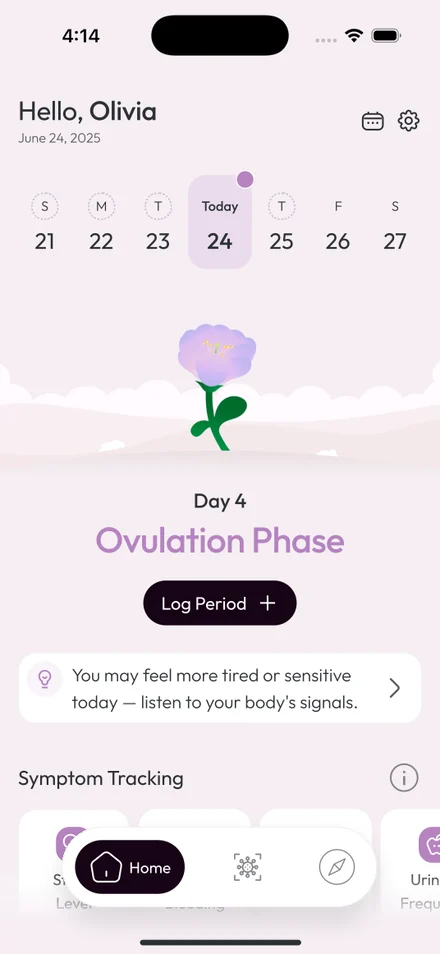
Your care doesn’t stop at the clinic door.
Nuvo Physio runs on Elle Santé — the women’s health platform we built right here. Your plan, your progress and your care team stay with you between visits, not just in the room.
Early access · iPhone and Android